
China Rapid Prototype Services: A Faster Way to Turn Ideas Into Products
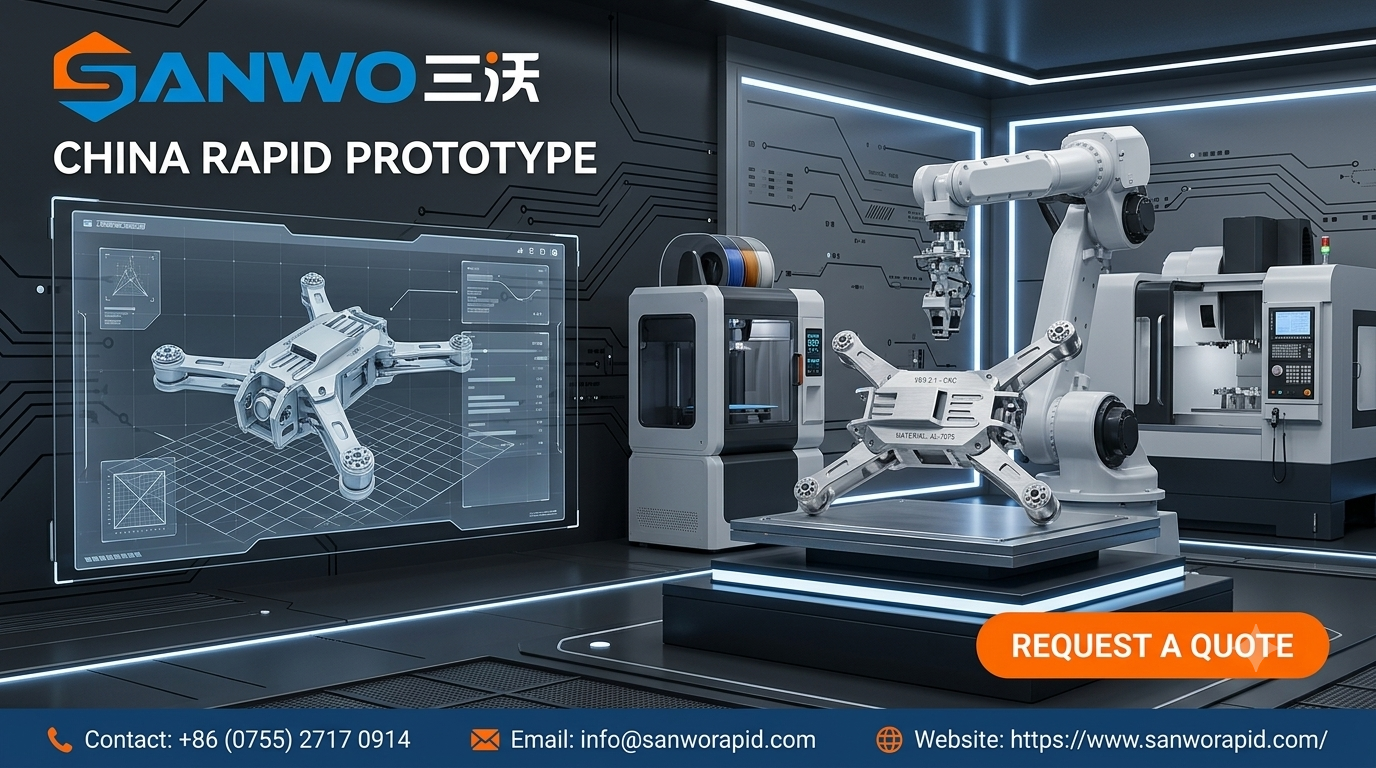
Turning a product idea into a real, functional part is rarely a one-step process. Between the first CAD drawing and the final production run, manufacturers need to test designs, check dimensions, identify weaknesses, and make improvements. This is where china rapid prototype services have become an important part of modern product development.
Instead of waiting weeks or months to create a physical model, businesses can work with experienced prototype manufacturers to produce accurate parts in a much shorter time. From CNC machining and aluminum prototypes to vacuum casting and rapid injection molding, the right manufacturing process can help companies move from concept to production with greater confidence.
For companies looking for speed, flexibility, and competitive manufacturing costs, SanwoRapid provides rapid prototyping and manufacturing solutions designed around different product development requirements.
What Is a China Rapid Prototype?
A china rapid prototype is a physical model or functional component manufactured in China from a digital product design. Depending on the project, the prototype may be produced using CNC machining, 3D printing, vacuum casting, sheet metal fabrication, or injection molding.
The purpose isn't simply to make a sample. A prototype gives engineers and product developers something tangible to test.
For example, imagine a company developing a new aluminum electronic enclosure. The CAD model may look perfect on a computer screen, but once the first prototype is manufactured, the engineering team might discover that a mounting hole needs to move slightly or that two components interfere during assembly.
Finding that problem during prototyping is far better than discovering it after thousands of production parts have already been manufactured.
That's why rapid prototyping is such an important step in product development.
Why Are Companies Choosing China for Rapid Prototyping?
China has developed a large and highly capable manufacturing ecosystem. CNC machining companies, injection molding manufacturers, sheet metal fabricators, finishing specialists, and other suppliers operate within an extensive industrial network.
This gives customers access to a wide range of manufacturing processes from a single sourcing market.
One of the biggest advantages is flexibility. A business may need a CNC-machined aluminum part for one project, vacuum-cast plastic housings for another, and sheet metal brackets for a third. An experienced manufacturing partner can help determine which process makes the most sense for each application.
Cost is another consideration, particularly for startups and businesses developing several design iterations. However, choosing a supplier based only on the lowest quotation can create problems later. Quality, communication, dimensional accuracy, material consistency, finishing, and delivery reliability should also be considered.
How Rapid Prototyping Helps Product Development
A physical prototype provides information that a CAD model simply cannot.
With a prototype in hand, teams can:
-
Check dimensions and tolerances
-
Test component fit and assembly
-
Evaluate ergonomics and appearance
-
Test mechanical performance
-
Identify manufacturing problems
-
Gather feedback from customers or stakeholders
-
Make design improvements before mass production
This process can save considerable time and money.
Faster Design Iterations
Product development rarely gets everything right on the first attempt. Designers may need to make several changes before reaching the final version.
Rapid manufacturing makes these iterations easier. Instead of waiting for a long traditional manufacturing cycle, companies can produce a new version, test it, collect feedback, and modify the design again.
This creates a practical design-test-improve cycle.
Lower Development Risk
The earlier a design problem is discovered, the easier and cheaper it is to correct.
A prototype can reveal issues with wall thickness, component interference, fastening locations, surface finish, material selection, or assembly.
This makes prototyping an important risk-reduction tool, especially for products with complicated mechanical or cosmetic requirements.
Popular Manufacturing Methods for China Rapid Prototype Projects
Different products require different manufacturing technologies. Choosing the right process depends on the part's geometry, material, quantity, tolerance, appearance, and intended use.
CNC Prototyping
CNC prototyping is a popular choice for functional parts that require high accuracy and good mechanical performance.
CNC milling and turning can produce components from materials such as aluminum, stainless steel, brass, copper, and engineering plastics.
For example, an automotive component that needs to withstand mechanical testing may benefit from CNC machining because the prototype can be manufactured from a material similar to the eventual production component.
Aluminum Prototype
Aluminum is one of the most commonly used materials for functional prototypes.
It is lightweight, strong, machinable, and available in several grades. An aluminum prototype can provide a much more realistic representation of a production component than a simple visual model.
It is particularly useful for housings, brackets, heat sinks, mechanical components, automotive parts, and electronic enclosures.
Sheet Metal Prototyping
Sheet metal prototyping is commonly used for brackets, cabinets, panels, enclosures, frames, and structural components.
Depending on the design, the manufacturing process may include laser cutting, CNC bending, welding, drilling, tapping, and surface finishing.
Creating a prototype before production helps engineers confirm bends, mounting points, dimensions, and assembly requirements.
Vacuum Casting
Not every prototype needs to be machined from metal.
Vacuum casting is useful when companies need multiple plastic or rubber-like prototypes with detailed shapes and attractive surface finishes. It can be a practical solution for functional testing, presentation models, and low-volume production.
Rapid Injection Molding
When the quantity increases, rapid injection molding can become an attractive option.
Unlike some prototype processes that produce parts individually, injection molding creates components using a mold and injected material. This makes it useful when a company needs a larger number of plastic parts or wants to evaluate production-like components.
What Should You Look for in a Prototype Manufacturer?
Finding a manufacturer is easy. Finding the right manufacturing partner requires more consideration.
Before selecting a supplier, look at several important factors.
Manufacturing Capabilities
Does the supplier offer the manufacturing process your product needs?
A company with CNC machining, sheet metal fabrication, vacuum casting, and injection molding capabilities can provide more flexibility as your project develops.
Quality Control
Ask how the manufacturer checks dimensions and material quality.
For precision components, inspection equipment and documented quality procedures can make a significant difference.
Engineering Support
A good supplier should do more than manufacture whatever is shown in a CAD file.
Experienced engineers can identify potential manufacturing problems and provide design-for-manufacturing suggestions before production begins.
Communication
Clear communication is especially important when working with an overseas manufacturer.
Drawings, specifications, tolerances, materials, finishing requirements, and inspection expectations should be clearly understood before production begins.
How to Prepare Your Design for Rapid Prototyping
Before requesting a quotation, make sure your design information is complete.
A manufacturer will typically need:
-
A 3D CAD file
-
2D engineering drawings when necessary
-
Material specifications
-
Required quantity
-
Surface finish requirements
-
Critical tolerances
-
Assembly information
-
Delivery requirements
You should also identify critical dimensions instead of applying extremely tight tolerances to every feature. Over-specifying tolerances can unnecessarily increase manufacturing costs.
Don't Ignore Design for Manufacturing
A design that works perfectly on a computer may still be difficult or expensive to manufacture.
Design-for-manufacturing, commonly called DFM, helps identify potential production problems before machining or tooling begins.
For CNC parts, this may involve checking deep cavities, internal corners, wall thickness, and tool accessibility. For injection molded parts, draft angles, wall thickness, ribs, bosses, and parting lines may require attention.
Getting this feedback early can prevent expensive redesigns later.
China Rapid Prototype vs. Traditional Prototyping
|
Feature |
China Rapid Prototype |
Traditional Prototyping |
|
Development speed |
Fast |
Often slower |
|
Process options |
Wide range |
Depends on supplier |
|
Design iterations |
Easy to repeat |
May take longer |
|
Material choices |
Extensive |
Supplier dependent |
|
Functional testing |
Available |
Available |
|
Low-volume production |
Often possible |
Depends on facility |
|
Production transition |
Can be streamlined |
May require another supplier |
The best choice ultimately depends on the product and project requirements. Rapid prototyping isn't about choosing the cheapest process—it is about choosing the right process for the stage of development.
Why SanwoRapid Can Be a Valuable Prototyping Partner
For product developers, working with a manufacturer that understands both prototyping and production can simplify the entire development journey.
SanwoRapid supports a range of manufacturing requirements, including CNC prototyping, aluminum prototypes, sheet metal fabrication, vacuum casting, rapid injection molding, and other rapid manufacturing solutions.
The objective is straightforward: help customers transform digital designs into accurate physical components while reducing unnecessary development delays.
Whether you're developing a new consumer product, automotive component, industrial part, electronic enclosure, or mechanical assembly, choosing the right prototype manufacturing process can make the development process more predictable.
Frequently Asked Questions
1. What is china rapid prototype manufacturing?
China rapid prototype manufacturing involves producing physical product samples or functional components through Chinese manufacturing suppliers using processes such as CNC machining, 3D printing, vacuum casting, sheet metal fabrication, and injection molding.
2. Why use a China rapid prototype supplier?
Businesses may choose Chinese prototype suppliers because of their broad manufacturing capabilities, competitive pricing, material availability, and ability to support different production technologies.
3. Is rapid prototyping only for startups?
No. Startups, engineering teams, established manufacturers, product designers, and large companies can all benefit from rapid prototyping.
4. What materials can be used for prototypes?
Common materials include aluminum, stainless steel, brass, copper, ABS, PC, nylon, POM, PMMA, silicone, and other engineering plastics.
5. Is CNC machining suitable for prototypes?
Yes. CNC machining is particularly useful when prototypes need accurate dimensions, good surface quality, and strong functional properties.
6. What is an aluminum prototype used for?
An aluminum prototype can be used for mechanical testing, assembly validation, functional testing, heat management evaluation, and appearance assessment.
7. When should I use vacuum casting?
Vacuum casting is useful when you need several detailed plastic or elastomeric parts without investing in conventional production tooling.
8. What is rapid injection molding?
Rapid injection molding is a faster approach to producing molded plastic components, making it useful for prototype quantities and low-volume production.
9. How can I reduce prototype manufacturing costs?
Providing accurate CAD files, clearly identifying critical tolerances, selecting practical materials, reducing unnecessary complexity, and obtaining DFM feedback can help control costs.
10. How long does rapid prototyping take?
The timeline varies according to the manufacturing process, part complexity, material, quantity, finishing, inspection requirements, and supplier capacity.
11. Can prototypes be surface finished?
Yes. Depending on the material and manufacturing process, prototypes can receive finishing options such as anodizing, painting, powder coating, polishing, bead blasting, plating, and other treatments.
12. Can a prototype supplier also handle production?
Many experienced manufacturers can support the transition from prototypes to low-volume and larger-scale production. Discussing future production requirements early can make this transition easier.
Final Thoughts
Product development becomes much easier when engineers can test a physical part instead of relying entirely on a digital model. That's the real value of a china rapid prototype—it turns an idea into something that can be measured, tested, improved, and validated.
From CNC prototyping and aluminum machining to sheet metal fabrication, vacuum casting, and rapid injection molding, the right manufacturing method can shorten development cycles and reduce production risk.
SanwoRapid helps businesses move from CAD concepts to physical prototypes and manufacturing solutions with a practical, engineering-focused approach.
Have a new product idea ready for testing? Contact SanwoRapid today and take the next step toward turning your design into a production-ready product.
Contact - +86 (0755) 2717 0914
Email ID - info@sanworapid.com
Website - https://www.sanworapid.com/

 English
 French
 Spanish
 Portuguese
 Deutsch
 Turkish
 Dutch
Dutch
 Italiano
 Russian
 Romaian
 Portuguese (Brazil)
 Greek
Greek