
Repair or Replace? How to Decide When a Home Appliance Part Fails
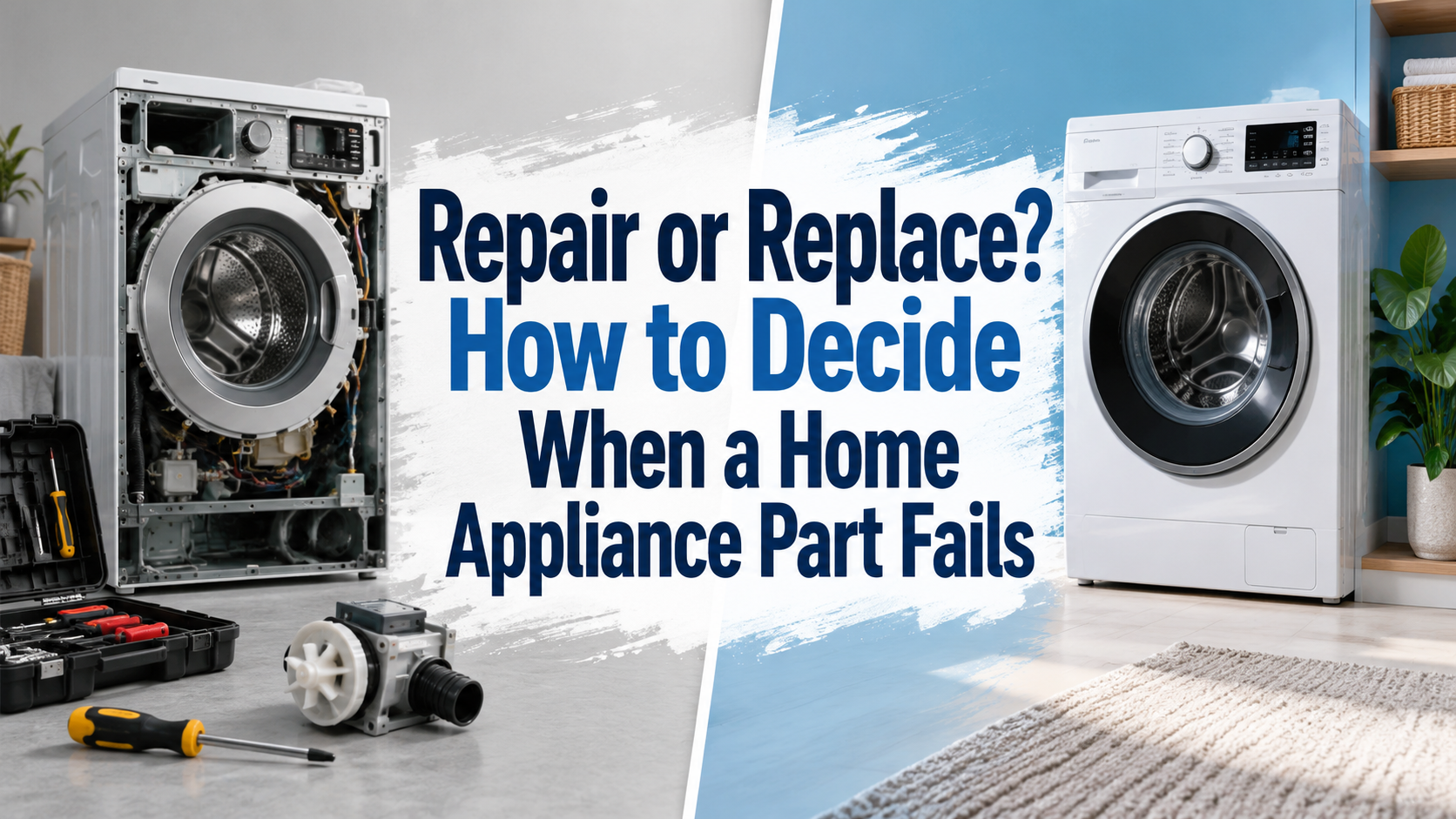
When a home appliance stops working, the first reaction is often simple: Do I need to replace the whole thing?
In many cases, the answer is no.
A refrigerator that is not cooling properly, a dishwasher that will not drain, or a dryer that suddenly stops heating may have a problem with one specific component rather than the entire appliance. Replacing the failed part can sometimes restore normal operation and help you avoid the cost and inconvenience of buying a new appliance.
At the same time, repairing an older or seriously damaged appliance is not always the smartest choice.
Knowing when to repair and when to replace can help you make a more practical decision.
Start by Identifying What Has Actually Failed
Before deciding whether an appliance needs to be replaced, determine what is causing the problem.
Many common appliance issues can be linked to individual components such as:
- Door switches
- Heating elements
- Water inlet valves
- Pumps
- Thermostats
- Filters
- Belts
- Sensors
- Seals and gaskets
- Control components
For example, a refrigerator that is not dispensing water may not need to be replaced if the issue is simply a clogged filter or faulty water-related component.
Similarly, a dryer that runs but does not produce heat could have a failed heating element rather than a problem with the entire machine.
Correctly identifying the faulty component is an important first step because a relatively small replacement part may solve what initially appears to be a major appliance failure.
Consider the Age of the Appliance
Age plays an important role in the repair-or-replace decision.
A relatively new appliance with one failed component is often worth repairing, especially if the rest of the machine is in good condition.
Older appliances require more consideration.
As appliances age, components naturally experience wear. One repair may solve the immediate issue, but other parts could begin failing later.
Before investing in a repair, consider:
- How old the appliance is
- Whether it has required previous repairs
- Whether replacement parts are still available
- Its overall physical and mechanical condition
- Whether it still performs efficiently
If the appliance has been reliable and the failure is limited to one replaceable component, repairing it may still make sense.
If several components are beginning to fail, replacing the appliance could offer better long-term value.
Compare the Cost of Repair With Replacement
Cost is usually one of the biggest factors.
Start by estimating what the repair would involve.
Consider the price of the replacement part, professional labour if required, diagnostic charges, and any additional components that may need attention.
Then compare that total with the cost of purchasing and installing a new appliance.
A minor part replacement can often be significantly less expensive than replacing an entire refrigerator, washer, dryer, dishwasher, or other household appliance.
However, repeatedly repairing an appliance with ongoing problems can eventually become more expensive than replacing it.
The goal should be to look beyond the immediate repair and consider the likely cost of ownership over the next few years.
Check Whether the Replacement Part Is Available
Part availability can influence the decision considerably.
Before giving up on an appliance, locate its model number and check whether the required replacement part is still available.
The appliance model number is usually found on a label or identification plate. Its location depends on the appliance and manufacturer, but it may be found:
- Inside a refrigerator compartment
- Around the door frame
- Behind an access panel
- On the back of the appliance
- Near the control area
Having the correct model or part number makes it easier to confirm compatibility.
When searching for replacement appliance parts, avoid choosing components based only on appearance. Parts that look nearly identical can have different dimensions, electrical specifications, connectors, or compatibility requirements.
Matching the part to the correct appliance model is much more reliable.
Look at the Appliance's Overall Condition
One failed component does not necessarily mean the appliance is finished.
Before making a decision, inspect the rest of the appliance.
Ask yourself:
- Is the appliance otherwise working properly?
- Are there unusual noises or vibrations?
- Is there significant rust or physical damage?
- Have other parts recently failed?
- Are doors, seals, controls, and moving components still in good condition?
If the rest of the appliance remains dependable, replacing a faulty component can often be worthwhile.
On the other hand, several problems appearing at the same time can indicate that the appliance is reaching the end of its practical life.
Know When a DIY Repair Makes Sense
Some appliance maintenance and replacement tasks are relatively straightforward.
Replacing certain filters, knobs, shelves, seals, batteries, or other accessible components may be manageable for homeowners who follow the manufacturer's instructions and understand the task.
Other repairs should be handled by qualified professionals.
Electrical components, gas appliances, refrigeration systems, complex internal wiring, and repairs involving significant disassembly can create safety risks when handled incorrectly.
If you are unsure about the diagnosis or repair procedure, professional assistance is usually the better option.
Saving money on a repair is valuable, but safety should always come first.
Consider Energy Efficiency
Repair cost is not the only financial factor.
Older appliances may consume more energy than newer models. If an appliance is already inefficient, requires frequent repairs, and is approaching the end of its useful life, replacing it may provide better long-term value.
However, replacing a functioning appliance simply because one affordable component has failed may not always be necessary.
Look at the complete picture: repair cost, appliance condition, expected remaining life, and operating efficiency.
When Repairing Usually Makes Sense
Repair is often worth considering when:
- The appliance is relatively new
- The problem is limited to one component
- The replacement part is readily available
- Repair costs are reasonable
- The appliance has otherwise been reliable
- There are no major safety concerns
In these situations, replacing the faulty component can extend the appliance's useful life without the cost of purchasing an entirely new unit.
When Replacement May Be the Better Choice
Replacing the appliance may make more sense when:
- It has required several repairs recently
- Major components are failing
- Replacement parts are difficult to find
- Repair costs are becoming excessive
- The appliance has significant physical damage
- It performs poorly even when working correctly
- Safety concerns are involved
The cheapest immediate option is not always the most economical long-term decision.
Finding the Right Replacement Appliance Part
If repair is the better option, accurate part selection becomes important.
Start with the appliance's brand, model number, and, when available, the original part number.
Suppliers such as Quick Parts Depot offer replacement parts and related products that can help homeowners maintain and repair household equipment. Searching by the correct appliance information can reduce compatibility mistakes and make it easier to identify the part needed for the repair.
Whenever possible, verify compatibility before ordering rather than assuming that a visually similar component will work.
Final Thoughts
A failed appliance part does not automatically mean you need a new appliance.
In many situations, one worn, damaged, or malfunctioning component is responsible for the problem. Identifying that component and installing the correct replacement can restore the appliance and extend its useful life.
But repair is not always the right answer.
Consider the appliance's age, condition, repair history, part availability, efficiency, safety, and total repair cost before deciding.
A thoughtful comparison between repair and replacement can help you avoid unnecessary spending while keeping the appliances in your home working reliably for as long as practical.

 English
 Arabic
 French
 Spanish
 Portuguese
 Deutsch
 Turkish
 Dutch
Dutch
 Italiano
 Russian
 Portuguese (Brazil)
 Greek
Greek