
Nonwoven Production Line: A Complete Guide for Modern Fabric Manufacturing
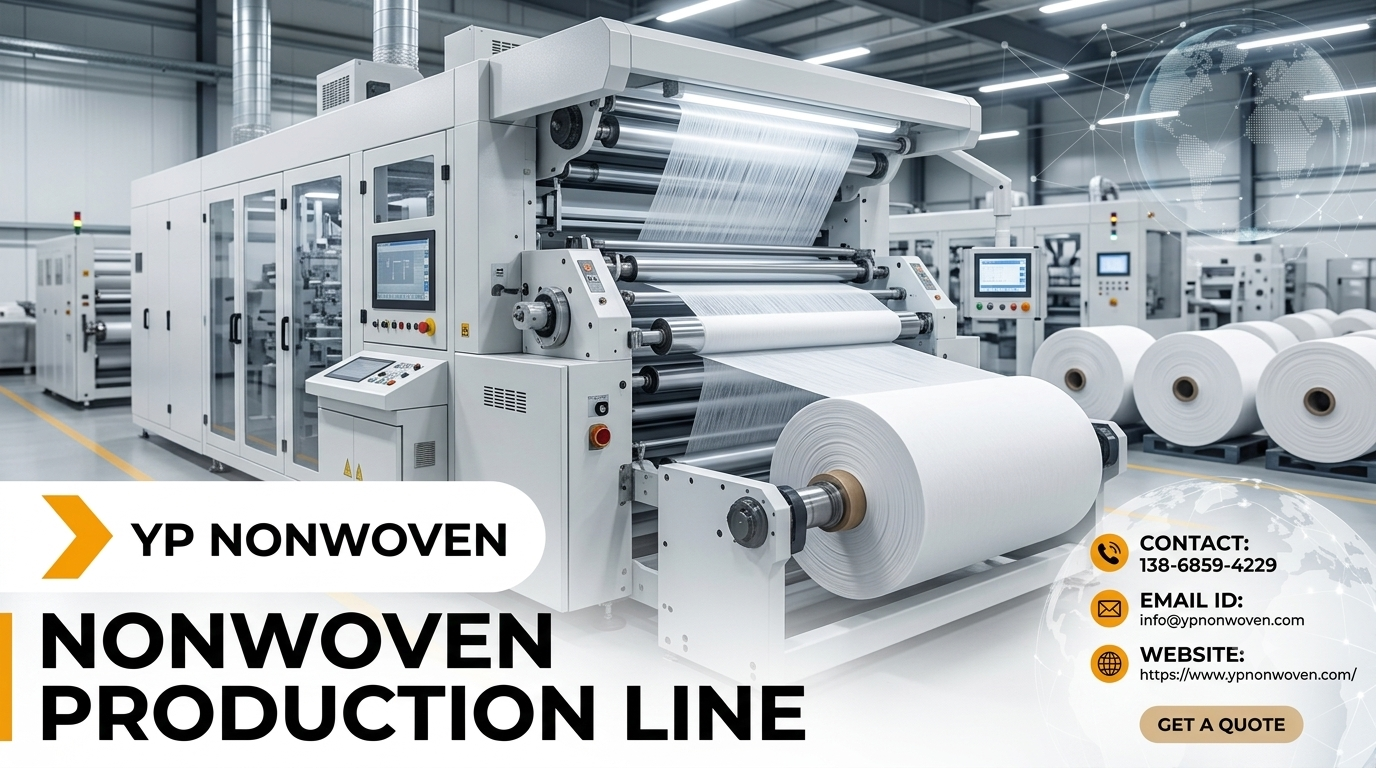
The nonwoven industry has become an important part of modern manufacturing because nonwoven fabrics are used in healthcare, hygiene, agriculture, construction, packaging, filtration, furniture, and many other sectors. Behind this growing demand is advanced manufacturing equipment such as a nonwoven production line, which allows manufacturers to produce consistent, high-quality fabric at commercial scale.
For businesses planning to enter the nonwoven industry or expand their existing production capacity, understanding how the production line works is essential. This guide explains the manufacturing process, major equipment, applications, benefits, and important factors to consider before investing in a production line.
What Is a Nonwoven Production Line?
A nonwoven production line is a complete manufacturing system used to produce nonwoven fabric from raw materials such as polypropylene (PP). Unlike woven textiles, nonwoven fabric does not require traditional yarn spinning and weaving.
Instead, the production process generally involves melting polymer, forming continuous filaments, creating a fiber web, bonding the web, and winding the finished material into rolls.
This streamlined process makes nonwoven manufacturing suitable for high-volume production while offering manufacturers flexibility in fabric weight, width, strength, color, and other properties.
For companies such as YPNONWOVEN, the focus is on developing machinery solutions that help manufacturers achieve reliable production, consistent fabric quality, and efficient operation.
How Does a Nonwoven Production Line Work?
Although the exact configuration can vary depending on the product, a typical PP spunbond manufacturing process follows several important stages.
1. Raw Material Feeding
The process begins with polypropylene granules. An automatic feeding system transfers the raw material into the extrusion system at a controlled rate.
Consistent material feeding is important because variations in the feed rate can affect extrusion stability and ultimately influence fabric quality.
2. Polymer Extrusion
Inside the extruder, polypropylene is heated until it becomes molten. The screw system mixes and transports the polymer while maintaining controlled temperature and pressure.
A stable extrusion process helps create uniform filaments and supports consistent production.
3. Filament Spinning
The molten polymer moves toward the spinneret, which contains numerous small openings. The polymer passes through these openings to form continuous filaments.
These filaments are then stretched using controlled airflow. Proper control at this stage is essential for achieving the desired fiber characteristics.
4. Web Formation
After stretching, the filaments are deposited onto a moving forming belt. They spread across the surface and create a continuous fiber web.
The machine parameters can be adjusted according to the required GSM, fabric width, and production specifications.
5. Thermal Bonding
The loose web needs to be bonded to become a strong and usable fabric. In many spunbond systems, heated calender rollers are used to bond the filaments together.
The bonding pattern and operating conditions can influence properties such as strength, appearance, softness, and durability.
6. Fabric Winding
After bonding and cooling, the finished nonwoven fabric is collected into large rolls.
Depending on the final application, manufacturers can then slit, print, laminate, cut, or convert the fabric into finished products.
Why Are Nonwoven Production Lines Becoming More Popular?
The demand for nonwoven materials continues to grow because manufacturers and end users need materials that are lightweight, versatile, economical, and easy to customize.
A modern production line can provide several advantages:
-
Continuous production
-
High manufacturing capacity
-
Consistent fabric quality
-
Flexible GSM options
-
Automated production control
-
Reduced manual labor
-
Efficient material utilization
-
Different fabric width options
-
Compatibility with multiple applications
-
Easier production scaling
However, simply purchasing a high-speed machine does not guarantee good results. Production efficiency also depends on raw-material quality, machine configuration, process control, operator skills, maintenance, and quality management.
Different Types of Nonwoven Production Lines
Manufacturers can choose different line configurations according to their target products.
|
Line Type |
General Configuration |
Common Uses |
|
S Line |
Single spunbond beam |
Agriculture, packaging, general products |
|
SS Line |
Two spunbond beams |
Hygiene, medical, packaging |
|
SSS Line |
Three spunbond beams |
High-quality and specialized fabrics |
|
SMS Line |
Spunbond + Meltblown + Spunbond |
Medical and filtration applications |
|
SMMS Line |
Spunbond + Meltblown layers |
Hygiene, filtration, technical applications |
The right configuration depends on the required fabric characteristics, production capacity, target market, and investment plan.
Where Is Nonwoven Fabric Used?
One of the biggest advantages of nonwoven technology is its wide range of applications.
Healthcare and Medical Products
Nonwoven fabrics are commonly used in disposable gowns, surgical drapes, caps, shoe covers, masks, and other healthcare products.
Hygiene Products
Nonwoven materials are important components in diapers, sanitary products, and other personal-care products because they can be engineered for softness, strength, permeability, and comfort.
Agriculture
Farmers and agricultural manufacturers use nonwoven materials for crop protection, plant covers, nursery applications, and other agricultural purposes.
Packaging
Nonwoven fabric can be converted into shopping bags, promotional bags, packaging materials, and reusable products.
Construction
Specialized nonwoven materials can be used in construction-related applications, including insulation, roofing components, protective layers, and other technical products.
Furniture and Automotive
Nonwoven fabrics are also used for furniture backing, padding, interior components, protective layers, and various industrial applications.
What Should You Consider Before Buying a Nonwoven Production Line?
Buying manufacturing equipment is a major investment. Before choosing a supplier, manufacturers should carefully evaluate their actual production requirements.
Define Your Fabric Requirements
First determine:
-
Target GSM
-
Fabric width
-
Required tensile strength
-
Desired production speed
-
Fabric color
-
End-use application
-
Annual production target
These specifications help determine the appropriate machine configuration.
Consider Production Capacity
A manufacturer should estimate current demand as well as future growth.
Choosing a machine with insufficient capacity may limit business expansion, while selecting excessive capacity can increase capital and operating costs unnecessarily.
Evaluate Automation
Automation can improve production consistency and reduce operator dependence. Look for systems that provide accurate temperature control, material feeding, process monitoring, winding control, and fault detection.
Check Technical Support
Machine quality is only one part of a successful project. Installation, commissioning, operator training, spare parts, maintenance support, and troubleshooting assistance can have a significant effect on long-term production.
How Can Manufacturers Improve Nonwoven Production Efficiency?
Even advanced machinery requires proper production management. Manufacturers can improve efficiency by following a few practical principles.
Maintain stable process parameters: Sudden changes in temperature, pressure, airflow, or production speed can affect fabric quality.
Use consistent raw materials: Variations in polymer quality can make process control more difficult.
Follow preventive maintenance: Regular inspection and maintenance can help prevent unexpected equipment failures.
Train operators properly: Skilled operators can identify abnormal conditions earlier and respond before defects become serious.
Monitor fabric quality continuously: Regularly check GSM, strength, width, appearance, bonding quality, and other specifications.
Why Choose YPNONWOVEN?
Choosing a machinery supplier should not be based only on machine specifications or advertised production speed. A reliable supplier should understand the manufacturer's application, production target, investment plan, and long-term requirements.
YPNONWOVEN focuses on nonwoven machinery solutions designed for different production needs. The company can help manufacturers evaluate suitable configurations according to fabric specifications, production capacity, automation requirements, and intended applications.
For a new factory, this technical guidance can be especially valuable because selecting the wrong configuration at the beginning can lead to unnecessary costs later.
Frequently Asked Questions
1. What is a nonwoven production line?
It is an integrated manufacturing system that converts raw materials such as polypropylene into nonwoven fabric through extrusion, spinning, web formation, bonding, and winding.
2. What material is commonly used in spunbond production?
Polypropylene is one of the most commonly used raw materials for PP spunbond nonwoven fabric.
3. Is nonwoven fabric woven?
No. Nonwoven fabric is produced by forming and bonding fibers or filaments rather than interlacing yarns through traditional weaving.
4. What does GSM mean?
GSM means grams per square meter. It represents the basis weight of the fabric and is an important specification in nonwoven manufacturing.
5. What is an SS nonwoven line?
An SS line generally uses two spunbond systems to create a multilayer spunbond structure with improved flexibility in fabric properties.
6. What is an SMS production line?
SMS means Spunbond-Meltblown-Spunbond. It combines spunbond and meltblown layers to produce a composite nonwoven material for specific applications.
7. Can nonwoven fabric be manufactured in different colors?
Yes. Color masterbatch can be added to the polymer system to manufacture colored nonwoven fabric.
8. What affects nonwoven fabric quality?
Raw-material consistency, extrusion conditions, filament formation, airflow, web distribution, bonding conditions, winding, and machine maintenance all influence fabric quality.
9. How can production waste be reduced?
Accurate material feeding, stable machine operation, preventive maintenance, operator training, and continuous quality monitoring can help reduce waste.
10. How should I choose a nonwoven production line?
Start by identifying your required fabric type, GSM, width, production capacity, raw material, application, automation level, and budget. Then select a machine configuration that matches these requirements.
11. Can production lines be customized?
Yes. Machine configuration, working width, output, automation, and auxiliary equipment can be selected according to the manufacturer's specific production requirements.
12. Why is after-sales service important?
Installation, commissioning, operator training, maintenance guidance, spare-parts availability, and technical support can help maintain stable production and reduce unnecessary downtime.
Contact - 138-6859-4229
Email ID - info@ypnonwoven.com
Website - https://www.ypnonwoven.com/

 Arabic
 French
 Spanish
 Portuguese
 Deutsch
 Turkish
 Dutch
Dutch
 Italiano
 Russian
 Romaian
 Portuguese (Brazil)
 Greek
Greek