
UV Disinfection Lamp Manufacturer and UV Ballast for Water Treatment: Essential Components for Reliable Purification
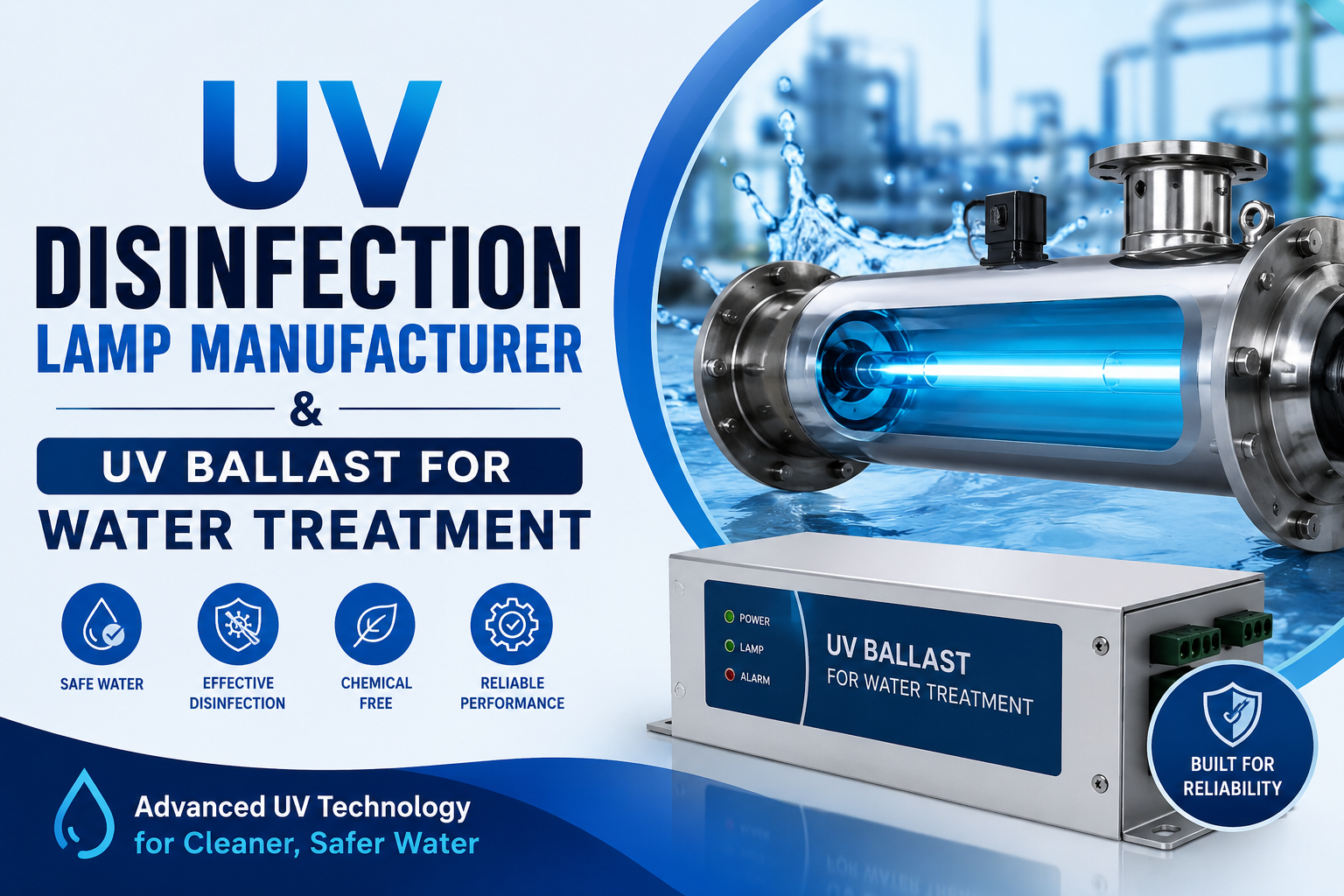
Clean and safe water is essential for homes, commercial facilities, healthcare centers, industries, and municipal treatment plants. As the demand for effective and environmentally responsible water purification continues to increase, ultraviolet (UV) disinfection has become a trusted technology. Unlike chemical treatment methods, UV systems can deactivate many microorganisms without adding chemicals to the water. However, the effectiveness of a UV system depends heavily on the quality of its main components, particularly the UV lamp and ballast.
Choosing a dependable UV Disinfection Lamp Manufacturer is therefore an important decision for businesses and water treatment professionals. At the same time, selecting the right UV Ballast for Water Treatment ensures that the lamp operates consistently and efficiently throughout its service life.
Understanding UV Disinfection Technology
UV water disinfection works by exposing water to ultraviolet light at a germicidal wavelength. When microorganisms such as bacteria, viruses, and other pathogens pass through the UV chamber, the UV energy can interfere with their ability to reproduce and function normally.
The process is attractive because it does not typically require chemical storage, dosing, or handling. It can also be integrated into different water treatment systems, ranging from residential purification units to large-scale industrial installations.
The UV lamp is the primary source of germicidal radiation. Its performance depends on factors such as lamp design, operating temperature, electrical stability, and the condition of the surrounding quartz sleeve. This makes the choice of manufacturer particularly important.
Why the Right UV Disinfection Lamp Manufacturer Matters
A professional UV Disinfection Lamp Manufacturer should provide lamps designed for consistent output, dependable operation, and compatibility with the intended treatment system. Water treatment applications can have very different requirements, so a one-size-fits-all approach may not always be suitable.
Quality UV lamps are engineered to provide stable UV intensity during operation. Reliable manufacturing also helps reduce the possibility of premature lamp failure, inconsistent performance, and unnecessary maintenance.
When evaluating a manufacturer, buyers should consider lamp specifications, operating life, electrical compatibility, construction quality, testing procedures, and after-sales technical support. A manufacturer with experience in water treatment applications can also help customers select the appropriate lamp configuration for their equipment.
The Importance of a UV Ballast for Water Treatment
While the lamp produces the UV energy, the ballast plays a critical electrical role. A UV Ballast for Water Treatment regulates and controls the electrical power supplied to the UV lamp. Without suitable electrical control, the lamp may not operate at its intended performance level.
A properly matched ballast can support stable lamp operation, efficient starting, and dependable performance. In commercial and industrial systems, where continuous operation is often required, ballast reliability is especially important.
Modern UV ballasts can be designed for specific lamp types and power ratings. Some systems may also incorporate features such as fault detection, lamp monitoring, and protection against electrical irregularities. Selecting a ballast that matches the lamp's electrical requirements helps create a more reliable overall treatment system.
Benefits of Using Compatible UV Components
The lamp and ballast should not be viewed as completely separate components. Their compatibility directly affects the performance of the UV treatment system.
Using a properly matched lamp and ballast can provide several advantages:
- Consistent UV lamp operation
- Improved energy management
- Reduced risk of electrical problems
- Longer and more predictable component life
- Easier maintenance and replacement
- More dependable water treatment performance
For this reason, water treatment equipment manufacturers and system integrators often work with experienced component suppliers who understand both UV lamps and their associated electrical systems.
Applications Across Different Industries
UV disinfection systems are used in many water-related applications. They can be found in drinking water treatment, wastewater treatment, food and beverage processing, aquaculture, swimming pool systems, pharmaceutical facilities, and industrial process-water applications.
Each application may require different lamp power, chamber design, flow capacity, and electrical configuration. Working with a knowledgeable UV Disinfection Lamp Manufacturer makes it easier to identify components suited to the specific application.
Similarly, a properly selected UV Ballast for Water Treatment can help maintain stable operation when systems are exposed to demanding working conditions or long operating cycles.
Making the Right Selection
Before purchasing UV components, it is useful to review the system's flow rate, lamp power, operating voltage, water quality, treatment objectives, installation environment, and maintenance requirements. Quartz sleeve condition and UV transmittance should also be considered because water characteristics can influence how effectively UV light passes through the treatment chamber.
The goal should not simply be to purchase the cheapest lamp or ballast. Reliable components can help minimize downtime and replacement costs while supporting consistent treatment performance over time.
Conclusion
UV technology offers an efficient approach to water disinfection, but the performance of a UV system depends on the quality and compatibility of its components. A trusted UV Disinfection Lamp Manufacturer can provide dependable lamps designed for specific water treatment applications, while the right UV Ballast for Water Treatment ensures that those lamps receive appropriate and stable electrical power.
By carefully selecting both components and ensuring they are properly matched, water treatment operators can build systems that are more reliable, efficient, and easier to maintain. For any organization investing in UV purification, choosing quality components is an important step toward achieving consistent and dependable water treatment results.
 Dutch
Dutch
 English
 Arabic
 French
 Spanish
 Portuguese
 Deutsch
 Turkish
 Italiano
 Russian
 Romaian
 Portuguese (Brazil)
 Greek
Greek