
Why Relying Too Heavily on Quotations Weakens Your Assignment
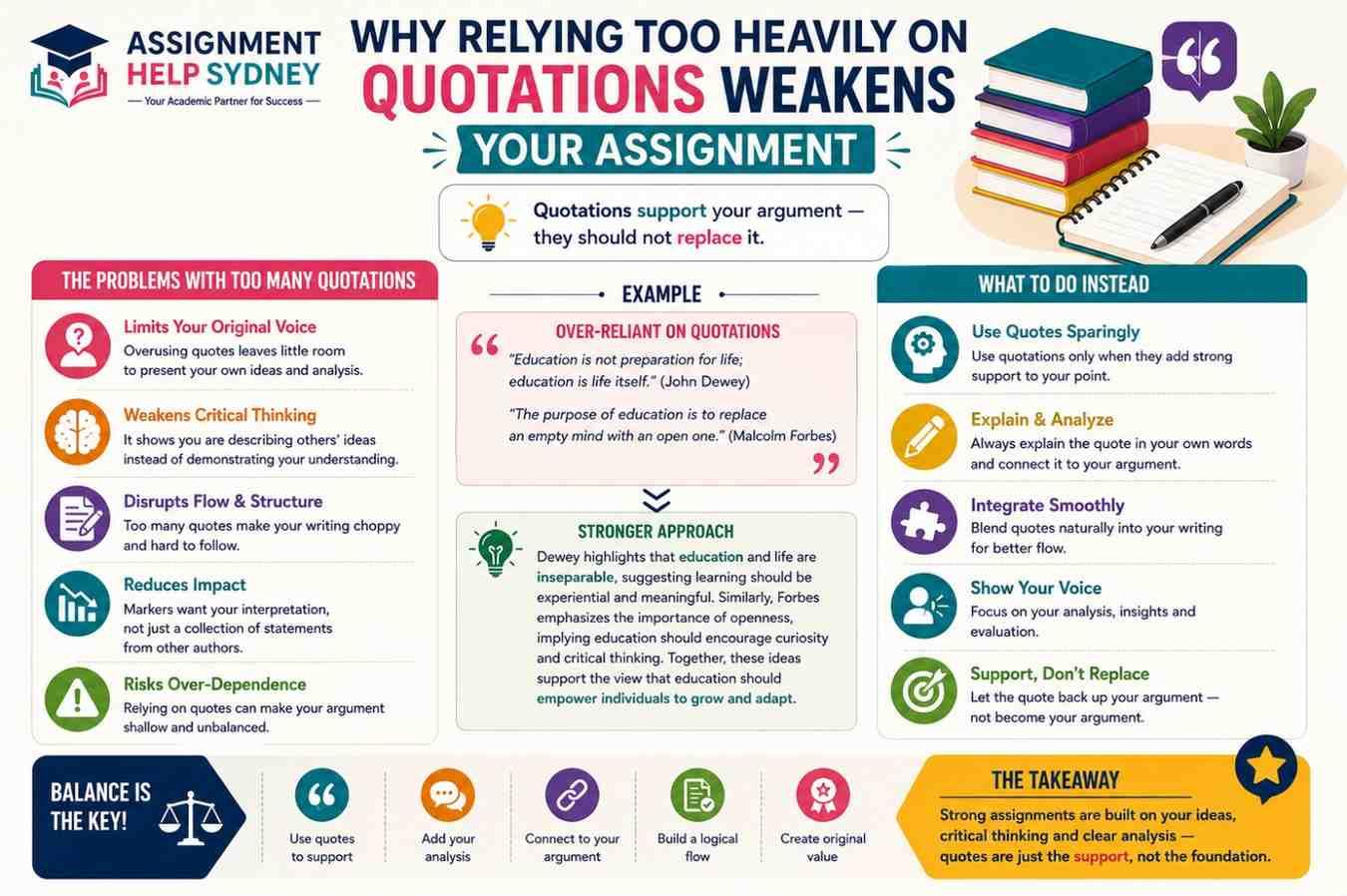
There is a comfortable habit many Sydney university students fall into when they are unsure of their own analytical voice — filling paragraphs with direct quotations from scholars, letting the experts speak instead of developing their own argument. It feels safe. It demonstrates that research was done. And it fills word count without requiring the student to take an analytical risk. The problem is that excessive quoting is one of the most reliable indicators to a marker that a student's own analytical thinking has not yet developed to the standard the assessment requires. Quotations are evidence — they are not arguments. The argument belongs to the student, and if it is absent, no amount of well-chosen quotations can substitute for it. This is one of the first things Assignment Help Sydney review services look for in a draft, because it affects every paragraph in an assignment and reflects directly on the analytical quality of the entire submission.
Why Quotations Cannot Do the Analytical Work for You
A direct quotation tells a reader what a scholar said. It does not, on its own, tell the reader what you think that scholar's contribution means for the specific question you are answering, how it relates to the claim you are making in this paragraph, or why it should change the reader's understanding of the topic you are addressing. All of that work belongs to the student's own sentences — the sentences that surround the quotation, frame it, explain it, and connect it to the central argument.
When those sentences are absent, or when they are thin — amounting to a brief introduction of the quotation and then a move to the next quotation — the assignment reads as a curated list of what scholars have said rather than as an argument the student is making.
The specific problems that excessive quotation reliance produces include the following:
- Paragraphs that are structurally quote-led rather than argument-led — where the scholarly voice dominates and the student's own analytical voice is almost entirely absent
- A reference list that is long but shallow, with many sources cited once or twice for a single quotation rather than a smaller number of sources engaged with analytically across multiple dimensions
- Conclusions that summarise what scholars said rather than what the student's own analysis demonstrated — because there was no independent analysis to synthesise
- A writing voice that shifts between the student's natural phrasing and the formal register of multiple quoted sources, creating inconsistency that markers notice immediately
- Word count that is technically met but that contains less original analytical content than a shorter, paraphrase-led response would
How to Shift From Quote-Dependent to Analytically Independent Writing
The shift away from excessive quotation reliance requires replacing the default habit of "find a quote that says this" with the more demanding habit of "decide what I want to say, then find the evidence that supports it."
This shift involves the following practical changes to the writing process:
- Defaulting to paraphrase rather than direct quotation — paraphrasing forces genuine understanding of a source, which produces better analytical engagement than selecting a sentence to lift verbatim
- Reserving direct quotations for moments when the exact wording genuinely matters — a key definition, a particularly authoritative statement on a contested claim, or language that would be distorted by paraphrase
- Writing the claim of each paragraph before finding its evidence — which prevents the reverse habit of finding a quotation first and then constructing a paragraph around it
- Spending at least as many words explaining a quotation as the quotation itself contains — if a quotation is three lines long and the explanation is one line, the analytical work has not been done
- Reviewing the final draft specifically to check whether any paragraph could function without its quotations — if the analytical content disappears when the quotations are removed, the paragraph is quote-dependent
How Assignment Help Sydney Review Addresses Quote Dependency
Assignment Help Sydney editorial review at the paragraph level identifies quote dependency as a structural pattern rather than as a problem with any individual sentence — and addresses it by showing the student specifically where their own analytical voice should be present and what kind of sentence would develop the argument rather than deferring it to a quoted source.
Conclusion
Quotations are a tool, not a foundation. They provide evidence for claims, but they cannot make claims themselves — and an assignment that relies on quotations to carry the argument has not yet developed the independent analytical voice that university assessment rewards. Assignment Help Sydney support that helps students shift away from quote dependency is building one of the most consequential writing capabilities a student can develop — the ability to use sources analytically rather than decoratively.

 English
 Arabic
 French
 Spanish
 Portuguese
 Deutsch
 Turkish
 Dutch
Dutch
 Italiano
 Russian
 Portuguese (Brazil)
 Greek
Greek